Solar panels and a fridge: self-consumption with Coopérnico prices
Quick answer
In this scenario, solar reduces electricity purchases for the fridge from €0.32 to €0.20 a day. That saves roughly €0.12 (36%).
- Consumption: 1.13 kWh/day
- Solar coverage after 15-minute settlement: 46%
- Purchase saving: 0.12 €/day
Self-consumption means using solar generation for your own consumption. Here, “coverage after settlement” also includes offsetting energy received from and sent to the grid within each 15-minute period. The unit kWh measures an amount of energy.
Simulation, not measurement: one fridge, hypothetical solar and no battery; all other household loads are excluded. Forecast purchase costs, including one estimated hour, exclude VAT and standing charges. Surplus revenue belongs to the solar installation. Do not extrapolate this day directly to a year.
Base scenario and assumptions
This isolated case does not represent an average home or fridge.
| Item | Value and scope | Origin |
|---|---|---|
| System and exclusions | One conventional fridge, solar panels and a grid connection; no battery. All other household loads are excluded. | Assumption |
| Location and periods | Lisbon, 14 October 2026. Full day 00:00–24:00 and 10:00–17:00 window; local time Europe/Lisbon (UTC+01:00 on that date). | Assumption |
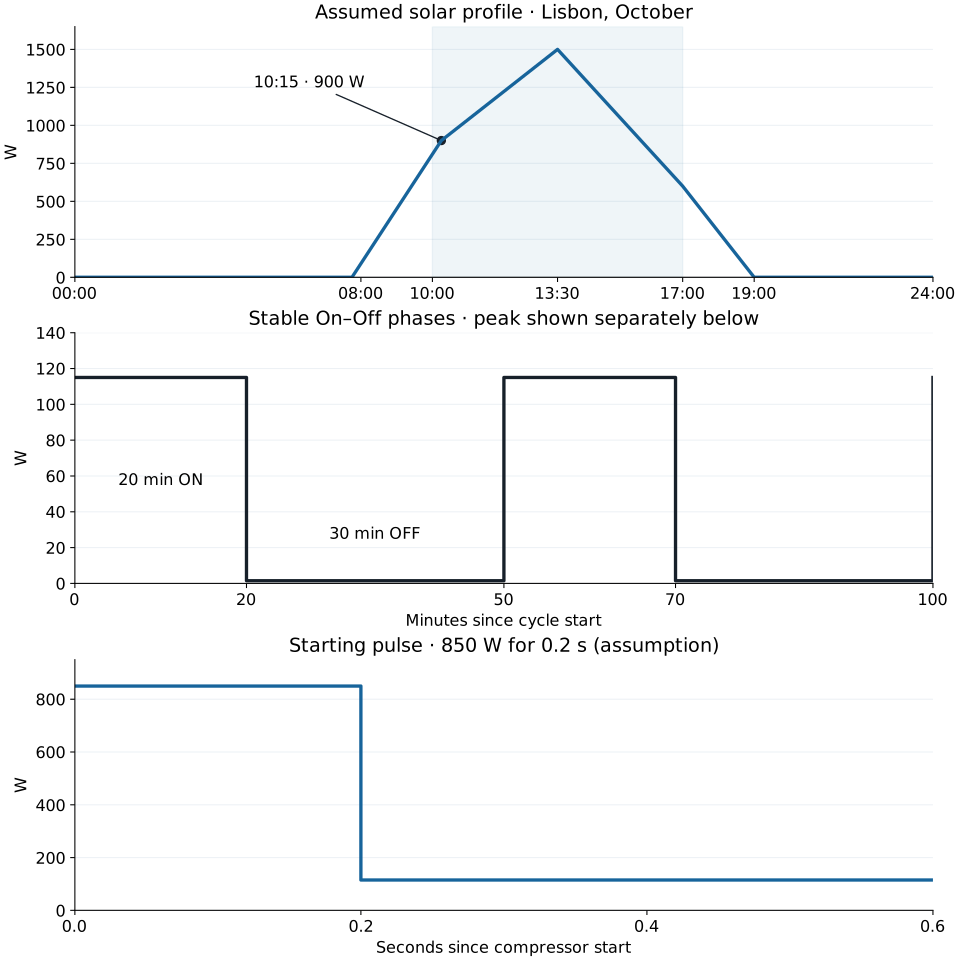
| Fridge | Repeats 20 min running at 115 W and 30 min standby at 1.5 W, starting at 00:00. The starting peak is another assumption; see the model. W measures power, not energy. | Assumption |
| Solar | Hypothetical power after conversion: 0 W at 07:45, 900 W at 10:15, 1500 W at 13:30, 600 W at 17:00, 0 W at 19:00. No weather, orientation or rated-panel model. | Assumption |
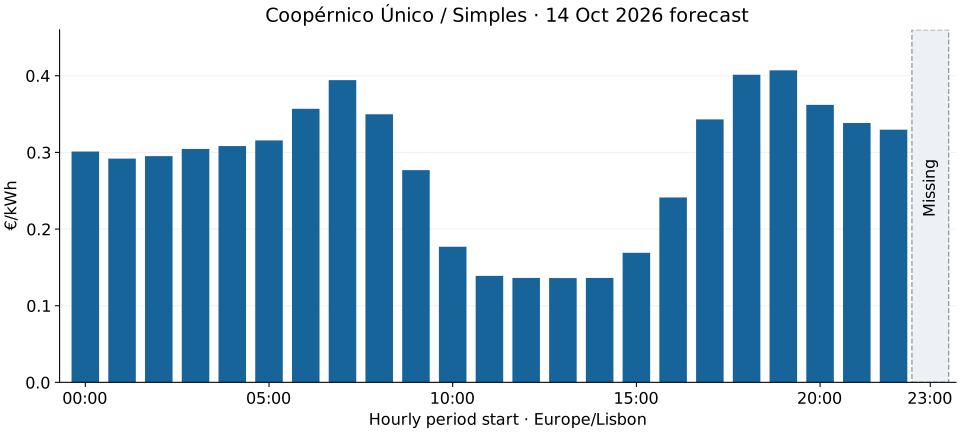
| Purchases | Saved Coopérnico Único/Simples forecast for 14 October 2026: 23 hourly prices, energy + network access tariff, before VAT. Forecasts, not final prices. [3] | External source |
| Missing hour | 23:00–24:00 is missing in the saved record; cause cannot be verified. Separate estimate: repeats the preceding €0.3297/kWh. This is not a published last-hour price. | Assumption |
| Sales | €0.05/kWh from another hypothetical buyer, under a contract. Coopérnico stopped buying surplus on 30 June 2026. [5] | Assumption / External source |
| Costs | Includes variable purchases at forecast prices (energy + network access). Excludes VAT, standing charges, other taxes/charges outside the forecaster, sales fees, investment and maintenance. | Assumption |
Results and what they mean
Calculated Values for this scenario. Full-day euro amounts use the missing-hour assumption.
Energy: how much does solar cover?
| Energy | 24 hours | 10:00–17:00 |
|---|---|---|
| Fridge consumption | 1.13 kWh | 0.35 kWh |
| Consumption covered after settlement | 0.52 kWh | 0.35 kWh |
| Grid purchases after settlement | 0.62 kWh | 0.00 kWh |
| Installation solar generation | 9.30 kWh | 7.79 kWh |
| Installation surplus after settlement | 8.78 kWh | 7.44 kWh |
Solar covers 45.73% of daily consumption after settlement. During 10:00–17:00 it covers 100% after settlement, with no settled purchases. The fridge still needs the grid outside solar production hours.
Money: savings on fridge purchases
| Comparison | 24 hours, estimate | 10:00–17:00 |
|---|---|---|
| No panels: purchases | 0.32 € | 0.06 € |
| Panels, no sales: purchases | 0.20 € | 0.00 € |
| Panels and sales: purchases | 0.20 € | 0.00 € |
| Purchase saving, with or without sales | 0.12 € | 0.06 € |
| Percentage saving | 36.30% | 100.00% |
Why does 46% energy coverage not save 46% in cost? Each kWh has a different price over the day. The energy avoided has a lower average price than the energy still purchased, mainly outside sunny hours. Cost therefore falls by about 36%, despite 46% energy coverage.
Surplus sales: separate installation revenue
Without a sales contract, revenue is €0. With another hypothetical buyer paying €0.05/kWh, the 8.78 kWh surplus would yield 0.44 € over the day (0.37 € during 10:00–17:00). This revenue is not fridge profit. Purchases remain the same with or without sales. [2][5]
The large surplus reflects the exclusion of other household loads. It is not a forecast for a real home. Purchases minus revenue is only a variable balance; it does not represent the full bill, profit or investment payback.
How 15-minute settlement works
Within each quarter-hour, energy received from and sent to the grid offsets for accounting purposes. This is quarter-hour settlement. The meter still records physical flows in both directions. Different quarter-hours do not offset automatically. [1]
Illustrative example — not an interval from the data
Between 12:00 and 12:15, 0.02 kWh enters from the grid and 0.05 kWh leaves. Settled purchases are 0 kWh and settled surplus is 0.03 kWh. In a later quarter-hour without solar, 0.02 kWh enters: that energy is purchased. The earlier surplus does not cancel it.
Settlement does not require an export contract. A contract lets you receive payment for surplus left after settlement. Without one, the surplus earns no revenue. [2]
Technical details: method and data
Optional reading. Index links open the relevant note directly.
Fridge model and formulae
The assumption ranges explored in this study are 80–150 W for 15–25 minutes on, 1–2 W for 20–40 minutes off, and a starting peak described as 500–1200 W for a fraction of a second. They are chosen assumptions for a compressor that alternates between running and standby (On–Off), not a verified Portuguese population average.
| Parameter | Central value |
|---|---|
| Running power | 115 W |
| On time | 20 minutes |
| Standby power | 1.5 W |
| Off time | 30 minutes |
| Starting peak | 850 W for 0.2 seconds |
| Complete cycle | 50 minutes |
| Mean frequency of this pattern | 1.2 starts/hour |
| Starts in the simulated day | 29 |
The 0.2-second duration is an explicit assumption. The peak replaces the first 0.2 seconds of the normal running phase. Cycles start at 00:00 and repeat every 50 minutes. The final cycle is truncated at midnight: this day contains 580 on minutes and 860 off minutes.
Up to three starts per hour cannot occur simultaneously with all the assumed duration ranges. Even the shortest combination, 15 minutes on plus 20 off, gives a 35-minute cycle: 60/35 ≈ 1.71 starts/hour. Three starts/hour would require a 20-minute cycle and different durations.
Some modern fridges use variable-speed compressors and can operate nearly continuously. This study concerns the specified On–Off pattern and does not generalise it to those appliances. [8]
Technical note: starting current and energy
Current is measured in amperes; W measures active power. Converting an inrush current to active power requires voltage and power factor. Here, 850 W of active power for 0.2 seconds is a deliberate approximation for energy integration, not an electrical measurement.
Extra energy per start is (850 − 115) × 0.2 / 3600 = 0.04083 Wh. Across 29 starts it adds 1.1842 Wh/day, about 0.104% of the day's 1134.35 Wh. A high, short peak can matter for inverter and electrical-system sizing while contributing little daily energy. Dynamic inverter response and protective-device trips are outside this model.
Settlement and cost formulae
For each interval q, Lq and Sq are integrated consumption and generation in kWh; pq is the purchase price for that hour, in €/kWh.
Iq = max(Lq − Sq, 0)— settled purchasesXq = max(Sq − Lq, 0)— settled surplusC0 = Σ(Lq × pq); C1 = Σ(Iq × pq)— cost without and with solarSaving = C0 − C1; % = 100 × (C0 − C1) / C0Coverage (%) = 100 × Σ(Lq − Iq) / ΣLqRevenue = ΣXq × 0.05 €/kWh
Sums are calculated before rounding. The full-day estimate alone substitutes the last-hour pq; the complete cost using all published prices remains null.
Daily saving (12 decimal places): 0.116280819583 €; 36.302715963%. Arithmetic precision does not measure assumption certainty.
Full data: solar, prices and results
Available solar power after conversion varies linearly between these points. It is a study assumption, without measurements or a weather model.
| Local time | Available AC power after conversion |
|---|---|
| 00:00–07:45 | 0 W |
| 07:45 | 0 W |
| 10:15 | 900 W |
| 13:30 | 1500 W |
| 17:00 | 600 W |
| 19:00–24:00 | 0 W |
It produces 7.7888 kWh during 10:00–17:00 and 9.3000 kWh over the day, including generation outside the high-generation window. The peak and timing are assumptions, not a forecast derived from one reading. At 10:15 the fridge draws 115 W, leaving 785 W of instantaneous surplus.
Coopérnico announced Único from 1 October 2026. It is market-indexed: Simples does not mean a constant price throughout the day. We use published hourly forecasts including energy and network access tariffs, before VAT. The source presents hourly averages of market prices and losses that vary every 15 minutes. Applying these averages to our load approximates effective billing. [3][4]
| Local time | €/kWh | Status |
|---|---|---|
| 00:00–01:00 | 0.3011 | Saved as published |
| 01:00–02:00 | 0.2919 | Saved as published |
| 02:00–03:00 | 0.2951 | Saved as published |
| 03:00–04:00 | 0.3045 | Saved as published |
| 04:00–05:00 | 0.3083 | Saved as published |
| 05:00–06:00 | 0.3157 | Saved as published |
| 06:00–07:00 | 0.3569 | Saved as published |
| 07:00–08:00 | 0.3943 | Saved as published |
| 08:00–09:00 | 0.3498 | Saved as published |
| 09:00–10:00 | 0.2769 | Saved as published |
| 10:00–11:00 | 0.1769 | Saved as published |
| 11:00–12:00 | 0.1389 | Saved as published |
| 12:00–13:00 | 0.1362 | Saved as published |
| 13:00–14:00 | 0.1361 | Saved as published |
| 14:00–15:00 | 0.1362 | Saved as published |
| 15:00–16:00 | 0.1690 | Saved as published |
| 16:00–17:00 | 0.2412 | Saved as published |
| 17:00–18:00 | 0.3431 | Saved as published |
| 18:00–19:00 | 0.4013 | Saved as published |
| 19:00–20:00 | 0.4071 | Saved as published |
| 20:00–21:00 | 0.3620 | Saved as published |
| 21:00–22:00 | 0.3384 | Saved as published |
| 22:00–23:00 | 0.3297 | Saved as published |
| 23:00–24:00 | Missing (null) | Missing in record |
The price snapshot preserves the 23 published values and a final null. The separate estimate uses €0.3297/kWh for the missing hour without labelling it a published price. The full-day purchase account is €0.191046 + 0.039374 kWh × the 23:00–24:00 price. Substituting the other hours' observed minimum and maximum gives illustrative costs of €0.1964–€0.2071. These are sensitivity scenarios, not guaranteed bounds or a confidence interval.
Forecast prices: purchases at night cost more on this day
Technical note: formula and source selection
The dated Único announcement gives Energy price = OMIE × (1 + FP) + k, with indicative mean losses of 15% and a €0.009/kWh margin. Other charges also exist. The tariff page still includes a numerical example using the earlier formula and 16% losses. We therefore use the explicitly labelled current Único/Simples forecaster rather than reconstructing a fixed price from that example. Its non-binding status is preserved. [3][4][6]
Hypothetical generation: energy remains during sunny hours
The earlier retrieval record reports a gap in both the HTML and the public chart response. Raw responses were not archived: we cannot now determine whether the hour was absent from the source or an extraction limitation caused the gap. Retrieval is dated 2026-10-14; retrieval time and timezone were not recorded. Europe/Lisbon identifies the data hours, not the retrieval time.
| Energy | 24 hours | 10:00–17:00 |
|---|---|---|
| Consumption | 1.134350833 kWh | 0.351367500 kWh |
| Settled purchases | 0.615653333 kWh | 0.000000000 kWh |
| Settled surplus | 8.781302500 kWh | 7.437382500 kWh |
After settlement, solar covers 45.73% of the fridge's daily needs. The large surplus reflects the deliberate exclusion of all other household loads.
Direct physical self-consumption is 0.509861 kWh. Physical imports are 0.624490 kWh and exports 8.790139 kWh. Settled quantities are smaller because imports and exports within each quarter-hour offset each other. During 10:00–17:00, starting peaks create about 0.01135 Wh of physical import, while settled purchases remain zero. [1]
For each of 96 intervals, we calculate purchase = max(consumption − generation, 0) and surplus = max(generation − consumption, 0) in kWh. We sum the results and price purchases with the corresponding hourly forecast. Settlement does not require an export sales contract: that contract pays for remaining surplus. Exports in one hour do not automatically pay for purchases in another. [1][2]
The 24 hourly values (including null), 96 intervals and all sensitivity results are in the reproduction files.
Daily purchases minus hypothetical revenue: -0.235037074 €; neither a bill nor profit.
Sensitivity: cycles, alignment and sales
| Scenario | Running / standby pattern | Daily consumption | Estimated purchases |
|---|---|---|---|
| Lower consumption | 80 W, 15 min / 1 W, 40 min | 0.5513 kWh | €0.1002 |
| Central | 115 W, 20 min / 1.5 W, 30 min | 1.1344 kWh | €0.2040 |
| Higher consumption | 150 W, 25 min / 2 W, 20 min | 2.0232 kWh | €0.3740 |
Starting peaks are 500, 850 and 1200 W respectively, each lasting 0.2 seconds. These are coherent scenarios within the assumed ranges, not a statistical distribution. Cycle timing also changes results slightly, mainly around the start and end of solar generation.
In the central case, every extra €0.01/kWh paid by another buyer adds about €0.0878 of daily revenue. The code retains €0.02/€0.05/€0.08 export scenarios; none is a confirmed commercial offer.
Model validation, limitations and next step
The calculation exactly integrates piecewise power, including subsecond starting peaks, and applies 15-minute settlement. It validates energy conservation, 96 intervals, solar polygon areas and daily load by an independent calculation. It retains incomplete cycles rather than rounding starts to an integer per hour.
Defrosting, door openings, room temperature and dynamic equipment behaviour are not separately modelled. For a real home, measure the fridge over several days and combine that with the installation's actual generation/consumption profiles and contracted tariff. Do not switch the fridge off to follow the sun. Do not multiply this sunny day's export income by 365 to forecast annual returns.
Reproduce the study
- Download the four files below, keeping their original names in the same folder.
- Run
python3 simulate.py(Python 3.12+, standard library, no network). The command checks calculations and rewritesresults.json. - Optional: open
study.ipynbin Jupyter; Matplotlib is needed to rerun its chart. Saved outputs and a chart are included.
- Simulation code — Python
- Published prices and separate assumption — JSON
- Full results and 96 intervals — JSON
- Calculations and chart — Jupyter notebook
To adapt this to your installation, measure the fridge over several days and use actual generation and consumption profiles and your contracted tariff. Do not switch the fridge off to follow the sun.
Sources
Checked on 2026-10-14. External sources support rules and prices; they do not establish the numerical fridge pattern or solar curve, which are study assumptions. The consultation date is not the publication date.
- E-REDES — Individual self-consumption: section “Esclareça alguns dos conceitos relacionados com as suas Leituras”: quarter-hour settlement and supplier readings. No publication date stated. https://www.e-redes.pt/pt-pt/ja-sou-autoconsumidor Return to text: ↩ 1 ↩ 2 ↩ 3
- ERSE — Self-consumption guide, 4 December 2024, PDF page 18, surplus: free supply to the grid or sale under a contract. https://www.erse.pt/media/0xpm5zro/faq-do-regime-de-autoconsumo_v20241117.pdf Return to text: ↩ 1 ↩ 2 ↩ 3
- Coopérnico — Price Forecaster: Único/Simples, reference 2026-10-14, informative hourly energy+network prices before VAT; “Explicador” section, no publication date stated. The earlier record describes extraction from the public page and confirmation against its chart response; raw responses were not archived. Last hour missing in the saved record; cause cannot be verified. Retrieval time/timezone were not recorded. https://coopernico.org/previsordeprecos Return to text: ↩ 1 ↩ 2 ↩ 3
- Coopérnico — Único tariff announcement, updated 31 August 2026: effective 1 October and revised formula. https://coopernico.org/artigo/466 Return to text: ↩ 1 ↩ 2
- Coopérnico — Surplus purchase service closure, updated 26 June 2026: effective 30 June, with another buyer possible. https://www.coopernico.org/artigo/313 Return to text: ↩ 1 ↩ 2
- Coopérnico — Tariff page: sections “Como calcular o preço final?”, “Fórmulas” and “Outras componentes da factura”. No publication date stated; the example uses a different formula from the stated tariff formula. https://coopernico.org/tarifarios Return to text: ↩ 1
- European Commission — Fridges and Freezers, “How efficient?”: historical 181 kWh/year reference for units sold in 2020. No publication date stated; used only in change history. https://energy-efficient-products.ec.europa.eu/product-list/fridges-and-freezers_en Return to text: ↩ 1
- Electrolux — Why does my refrigerator run most of the time?: “Solution” section: variable-speed models and environmental/usage effects. No publication date stated; it does not establish the chosen On–Off values. https://support.electrolux.ca/support-articles/article/1847710-refrigerators-why-does-my-refrigerator-run-most-of-the-time-is-this-normal- Return to text: ↩ 1
Change history
- 14 October 2026 — editorial organisation: added summary, self-contained scenario, differences and percentages, technical shortcuts and source return links. Clarified the missing-hour uncertainty. Numerical model and results preserved.
- 14 October 2026 — model revision: compressor with 20/30-minute cycles and Coopérnico forecast prices; replaces earlier equivalent-power calibration and a fixed price.
Historical model comparison
| Comparison | Earlier model | Revised model |
|---|---|---|
| Daily consumption | 0.4960 kWh | 1.1344 kWh |
| Settled purchases | 0.2663 kWh | 0.6157 kWh |
| Settled surplus | 9.0703 kWh | 8.7813 kWh |
| Purchases at the old fixed €0.20/kWh | €0.0533 | €0.1231 |
| Estimated purchases with Coopérnico forecast | €0.0887 | €0.2040 |
This separates two effects: the conventional fridge consumes more, and prices during hours without solar exceed the earlier €0.20/kWh assumption. The historical European 181 kWh/year reference no longer calibrates this model. It describes units sold in 2020, not a consumption requirement for Pedro's . [7]